
01
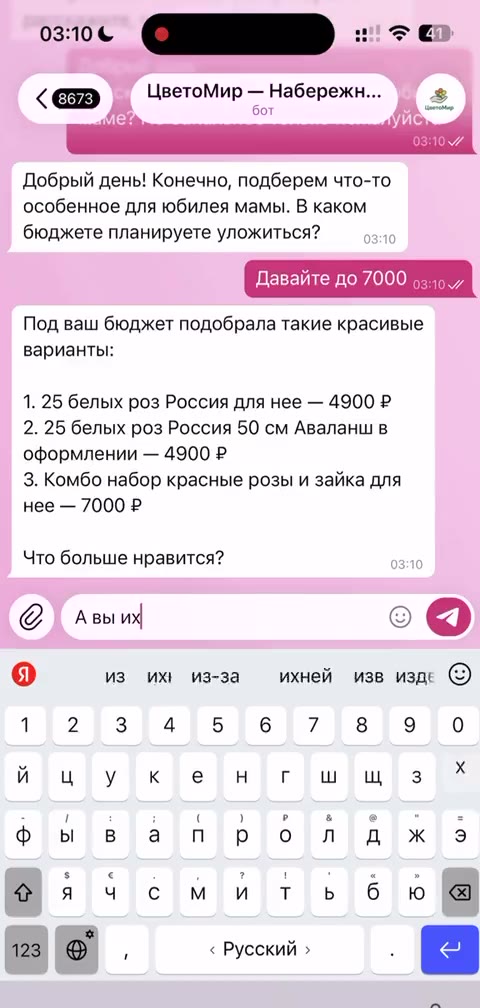
A consultation on an online store website
The customer asked about availability and timing, the bot answered, suggested suitable options and collected the lead.
Embeds into your website, Telegram, WhatsApp, VK and MAX. Answers in seconds, takes the customer to a lead and a payment, logs it in your CRM and sends reminders. 24/7, with no salaries, no motivation issues and no “didn't get to it in time.”
We'll show you real chats from live projects.
Companies already using our AI solutions












Replies instantly in any channel, at any time of day
Takes the customer to a lead, a payment or a booking
Collects the data itself and drops a ready lead into the CRM
Takes the stream of routine questions off your managers
A solution adopted by both large companies and small teams. We've been delivering AI bots to businesses for years.
messages handled by our text bots across our clients' projects in 2025
The bot replies in seconds in any channel — the customer doesn't leave for whoever answered faster.
We'll help pick a solution for your business and calculate the gain on your own numbers.
They reply to customers in seconds, answer questions, collect leads and hand the manager a ready-to-work request. They run on your website, in Telegram, WhatsApp, VK, MAX and other messengers. We connect them to your CRM.
A fit for businesses where customers write into chats but some leads slip away because of slow replies and messy conversations.
Real chats from live projects — no sign-up required

Our solutions are already running in more than 5,000 businesses across very different niches. You don't have to experiment or take a risk — you get a scenario that works reliably and delivers results.
If the customer journey can be described with questions, answer options and a clear next step, it can be automated. An AI chatbot handles routine inquiries on its own, takes the customer all the way to a lead or a payment, and leaves managers for the complex, high-value conversations.
The bot takes over reference questions, simple matching, sending materials and initial qualification.
When every simple conversation goes through a manager, the cost of handling a lead grows. Automation lets you close part of the inquiries cheaper.
Bookings, orders, a consultation along a clear scenario and sending a quote can all run through the bot. People are left with negotiations, non-standard requests and high-potential customers.
More traffic usually means more conversations and more staff. With a bot, routine inquiries can be handled without your team growing proportionally.
The bot takes over the first contact, routine questions and lead collection. Complex conversations, negotiations and non-standard cases stay with your managers.
It doesn't matter when the customer writes — at lunch, at night or on a weekend. The bot answers right away, without waiting for a free manager.
Answers questions about hours, prices, what a service includes, delivery, availability and any routine topics. It relies on your knowledge base.
Clarifies what the customer needs and suggests suitable options. A fit for businesses with a wide catalog or several service formats.
Clarifies city, budget, timeline, format — whatever matters in your niche. The manager gets a ready request with the data already collected.
Offers available time slots, locks in the visit and syncs with your CRM or booking system.
Sends reminders and instructions, confirms payment, walks the customer through the deal. A fit for businesses with a long sales or service cycle.
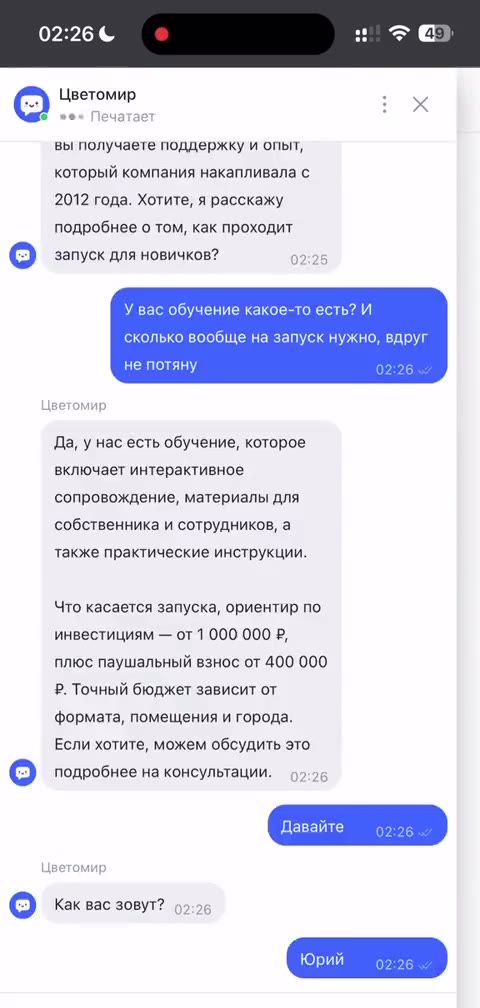
These aren't marketing scripts or a cut of the best answers. Real chats from live projects — so you can see how the bot talks, clarifies and collects a lead.
The customer asked about availability and timing, the bot answered, suggested suitable options and collected the lead.
The bot reminded about a payment, sent an instruction and answered a routine question.
All the conversations are real. You'll have your own — tailored to your business, tone of voice and scenario.
A chat widget on any page. A fit for businesses with inbound traffic from ads, search or organic.
A Telegram bot as a channel for talking to customers and taking leads. A fit for B2B, education and services with long communication cycles.
WhatsApp Business as the main messaging channel. A fit for retail, services, delivery and local businesses.
Community messages and direct chats in VK. A fit for businesses with an active presence on VK.
A Russian messenger that's rapidly gaining users. The connection works out of the box — relevant for businesses focused on the Russian audience.
Where possible we connect the channels you need — Avito, Viber, in-app social messengers. During the discussion we look at which channels you actually use.
Online stores, delivery, restaurants, services, real estate agencies, education projects, service companies. When conversations come in a stream, the bot handles the first contact reliably.
Any B2C business with active advertising. Part of the traffic arrives in the evening and on weekends — managers are off, but the bot replies instantly.
Clinics, salons, fitness, education, services with a price list, B2B with consultations. The bot covers the basic questions and leaves the complex conversations to managers.
B2B services, agencies, realtors, lawyers, consulting. The bot gathers the initial information and hands the manager a prepared request.
A visitor came in and asked a question — the bot answered, clarified the details, collected the contacts and handed them to a manager. A fit for businesses with an active website and advertising.
All inbound from WhatsApp, Telegram, VK, MAX and other channels is handled by the bot. It closes simple questions on its own and passes the complex ones to a manager.
The customer describes what they need, the bot suggests suitable options from the catalog. A fit for online stores and services with a wide price list.
The bot clarifies the service format needed, offers available slots, locks in the visit and syncs with your CRM or booking system.
The bot gathers information about the company, the size of the request, timelines and the contact person. The manager joins the conversation with a clear request in hand.
In long deals the bot reminds about payments, sends documents and instructions, and answers questions about each stage.
The bot sends personalized messages to messengers — about order status, promotions, events, subscription renewals. Not spam, but targeted messages by segment.
After a lead the bot sends a price list, instruction, presentation, video or other material. A fit for businesses where quick delivery of routine documents matters.
The customer gets an answer right away, at any time of day. They don't leave for a competitor while a manager looks for a free minute.
The team no longer answers about hours, prices and delivery forty times a day. The bot takes that load.
Not just a new message, but a structured request with the data already collected. Fewer back-and-forth clarifications, a faster move to the deal.
The bot answers equally correctly regardless of the shift or workload. The customer doesn't have to repeat the question to different managers.
You can see who wrote in, what the bot answered, at which step the lead stalled and what to do next.
We study how customers are talked to today, which questions come up most often and where leads get lost.
We don't try to automate everything at once. We take one task: first line on the website, a messenger, qualification or a specific scenario.
We write the dialog logic and gather the materials the bot relies on for its answers: hours, prices, services, routine questions.
We put the bot on your website, in a messenger or social network and set up lead delivery into your CRM.
We watch how it works on real conversations, refine the wording and expand the scenario over time.
The market promises “a bot indistinguishable from a human.” We're in production every day and we see where the marketing ends and reality begins: no one has solutions like that yet. What we do build are strong bots that confidently hold the first line — and we're honest about where their limits are and where a human is needed.








The bot is placed where customers already write — on your website, in Telegram, WhatsApp Business, VK, MAX and other messengers. Leads and data are passed into your CRM. For the leading systems the integration works out of the box; if a system has an API, we integrate with it. Closed systems we discuss individually.
Our solutions handle routine questions well when the bot has a solid knowledge base and a clear scenario. We set things up so the bot relies on your materials — hours, prices, services, policies — and doesn't invent answers out of thin air.
If the bot hits a question with no answer in the base, it doesn't try to guess. It either honestly says the question is outside its scope or immediately passes the conversation to a manager. This is built into the logic from the start.
Before launch we test the bot on real conversations and refine the wording. After launch we watch the chats for a while and tune whatever needs it.
If a business gets 10 leads a month and a manager keeps up by hand, a text bot would just be in the way.
If the niche depends on deep personal contact from the very first message and any automation would push the customer away — we'll say so.
A bot is useful where there are many conversations, the questions repeat, leads get lost on the speed of the first reply, or there's a steady stream of routine inquiries. If there's no such task, automation would be redundant, and we won't pitch it.
On routine questions — yes, the answers will be natural and to the point. On complex conversations the bot hands the chat to a manager.
That's a normal situation — most businesses don't have a base set up for a bot, and we're comfortable working with that. At the start we go through the routine questions, the price list, hours and services and put the materials into a form the bot can rely on. With 5,000+ clients behind us, we often advise on funnels and sales scripts too.
In most cases, yes. For the leading CRMs (Bitrix24, amoCRM, YCLIENTS, МойСклад, 1С) the integration works out of the box. Closed systems we look at individually — if there's an API, we connect.
Usually from two to four weeks. It depends on the number of scenarios, how ready the knowledge base is and how complex the integrations are.
The cost depends on the number of channels, the volume of conversations and the complexity of the scenario. Up front we work out the economics specifically. In most cases a bot costs less than hiring new managers for the same volume.
In most cases the bot takes over the routine, while people work where live selling, negotiations and non-standard situations are needed. In some niches clients cut the load so much that they move staff to more complex tasks.
It hands the conversation to a manager. This is built into the logic from the very start.
You can and should. Most clients start with one channel — usually the one with the most inbound. From there we expand to the rest. If calls are a pain point too, take a look at voice AI bots, and if you need video content — AI avatars.
You don't need to know in advance. Tell us where leads are getting lost today or which questions your managers struggle with, and we'll suggest one or two options worth starting with.
On routine questions it's not critical — what matters to the customer is getting an answer quickly and to the point. On complex conversations the bot hands the chat to a manager.
The main language is Russian. When needed we enable work in 10+ languages — relevant for businesses with an international audience.
Tell us which channels your leads come through now and where the most of them are lost. We'll help you figure out whether it makes sense to launch a text bot and which channel or scenario is best to start with.